
On Saturday, we opened the zoo’s newest botanical attraction, a pollinator-friendly garden named Beeporzoona. But why are pollinator-friendly gardens being talked about more and more, and what actually makes a garden pollinator-friendly?
Our institution, the Budapest Zoo and Botanical Garden – as its official name also shows – is not only a zoo but also a botanical garden. Of course, every zoo operates in a landscaped environment, but a botanical garden means more than that: it is a curated plant collection with the value of an arboretum or botanical garden. Although our zoo is known for presenting the widest variety of animal species among Hungarian zoos, and our animal collection is considered especially diverse even by international standards, the number of plant species we present actually exceeds the number of animal species. In addition, our zoo is a member of several botanical garden organisations, including the Association of Hungarian Arboreta and Botanical Gardens (MABOSZ) and the Botanic Gardens Conservation International (BGCI).
Among the rich and diverse botanical attractions of our zoo, the newest element is the pollinator-friendly garden, which is actually a zone along the edge of the Biodome’s outdoor enclosures and the surrounding walking paths. We named this area Beeporzoona. Its main idea is that this zone was designed not only for aesthetic reasons, but also according to the needs of pollinators.
In the plant world, there are many different ways of pollination. There are also many wind-pollinated plants, but a large part of plants are pollinated by animals. For most people, bees are the most obvious pollinators, mainly because among the animals that play this role in nature, bees are the closest to humans, as they are among the domesticated species. However, bees are not the only pollinators, and insects are not the only animals that perform this role, even if most pollinators belong to the insect world. Mammals can also be pollinators: for example, fruit-eating bats pollinate many tropical plants, and some marsupials, such as honey possums, can also play this role. There are even pollinators among birds, for example hummingbirds.
In Hungary, however, the animals that pollinate plants are essentially all insects. Wild bees, bumblebees, hoverflies, butterflies, and flower-visiting beetles are among the most important.
Unfortunately, a worldwide trend can be observed: pollinating insects are becoming rarer or disappearing, mainly due to human activity. The causes include widespread pesticide use, intensive agriculture, habitat loss, climate change, and even certain gardening practices that favour “tidy” but ecologically poor gardens. This is why pollinator-friendly gardens are important, as they provide a kind of refuge for pollinating insects.
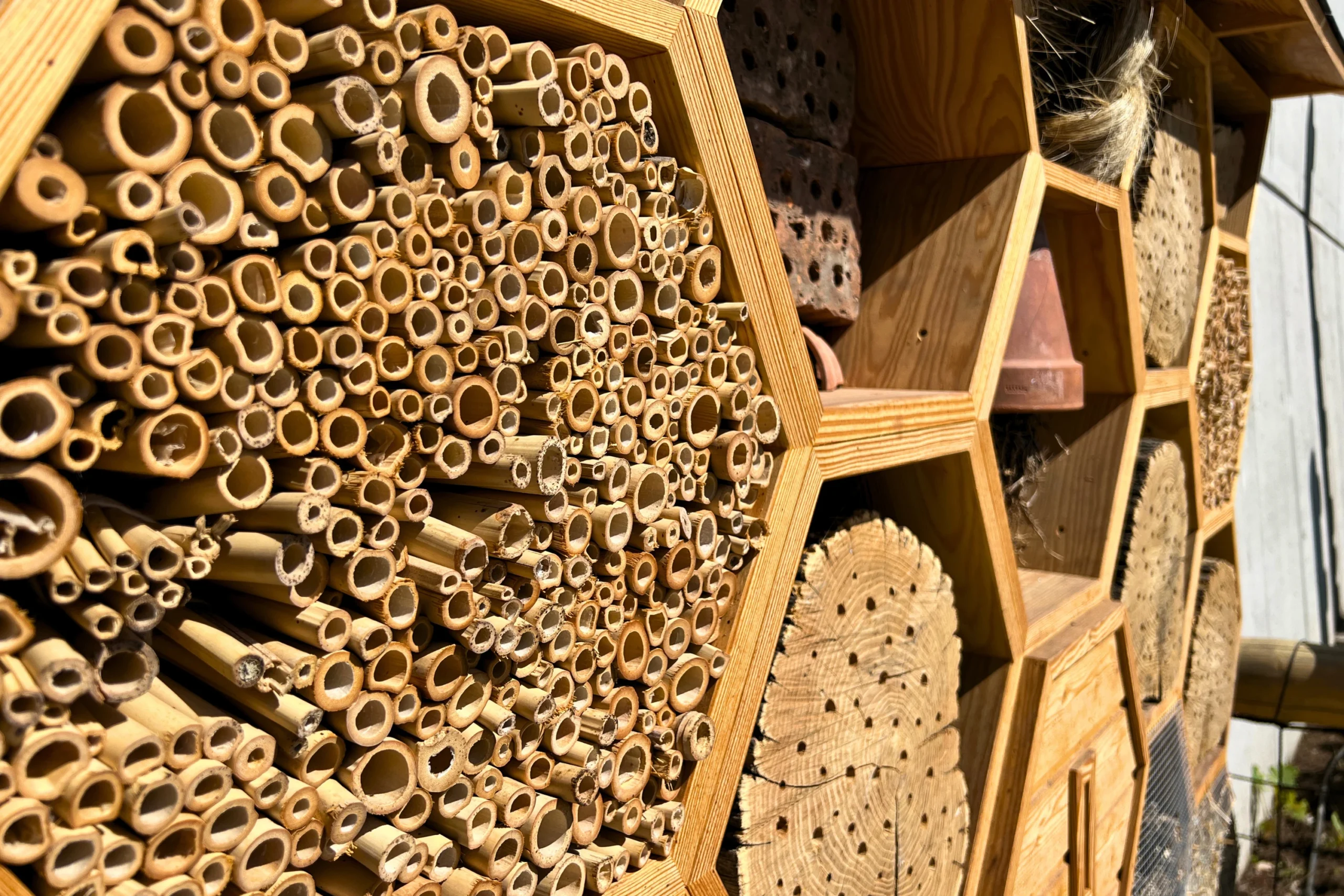
A key feature of pollinator-friendly gardens is that plants are selected so that from early spring until the arrival of frost – meaning throughout the full activity period of temperate-zone insects – there are always flowering plants available. It is also important that, instead of ornamental varieties that often produce less nectar and are harder for insects to access, the garden includes plants that better meet the needs of pollinators. The use of native plant species is especially beneficial, as local insect species are naturally best adapted to them. In a pollinator-friendly garden, pesticide-free maintenance is essential, as well as features that support insects’ needs. These include nesting places such as insect hotels, dead wood, leaf litter zones, and patches of bare soil. A safe drinking place is also needed, where pollinators can access water without the risk of falling in and drowning. All of these elements are present in the zoo’s Beeporzoona.
We have long planned to create a pollinator-friendly garden in our zoo. Not only because it is important from a conservation and ecological point of view, but also because we want to set an example. It is no coincidence that Beeporzoona was opened on the same day as the zoo’s open day for teachers. Protecting pollinators is also an important topic in our zoo education programmes. That is why we have created many educational panels and interactive elements in Beeporzoona, so that visitors can learn about the ecological relationships between plants and pollinators, and even get ideas for creating their own pollinator-friendly gardens at home.
Beeporzoona also includes the “Buzzing Path”, a learning trail about bees and beekeeping developed by the zoo in cooperation with the National Hungarian Beekeeping Association. The creation of Beeporzoona was carried out in cooperation with BKM FŐKERT and the Zoo Foundation. Beeporzoona itself, including the “Buzzing Path”, was opened together with the National Hungarian Beekeeping Association. At the opening ceremony, Péter Bross, president of the association, and András Botond Győry, head of the Zoo’s Education and Interpretation Department, gave welcome speeches.
At the end of the article, cynicism should also be mentioned. It is often observed that important and positive initiatives are accompanied by cynical remarks. For example, regarding pollinator-friendly meadows, some people say it is simply a trendy name for weeds. In reality, weeds are plants that are considered useless from a human perspective, and in cultivated areas they compete with useful plants for space, light, and nutrients. However, the concept of pollinator-friendly gardens goes against this way of thinking – or at least balances it – which is reflected in the terms “weed” and “unwanted plant”, where only what is useful to humans is considered worthy of growing. This approach is clearly not sustainable. On the other hand, if people understand that it is also in their own interest to have pollinators and pollinator-friendly gardens, then the way we define useful and useless plants also changes.
Another point where it is worth being cautious with cynical remarks is the honeycomb-shaped raised beds of Beeporzoona, whose outer walls are made of COR-TEN steel. To a superficial observer, these may simply look like rusty metal sheets. In reality, COR-TEN steel – now widely used in construction – is a type of steel that forms a rust-coloured, corrosion-resistant protective layer on its surface, which protects the steel underneath from further rusting.