
Time flies! It feels like only yesterday that Samu, the third calf of our elephant breeding pair, Angele and Assam, was born. In reality, however, more than five years have passed since then. From a biological perspective, the time had come for the young elephant to leave his “family home” and move to a new place.
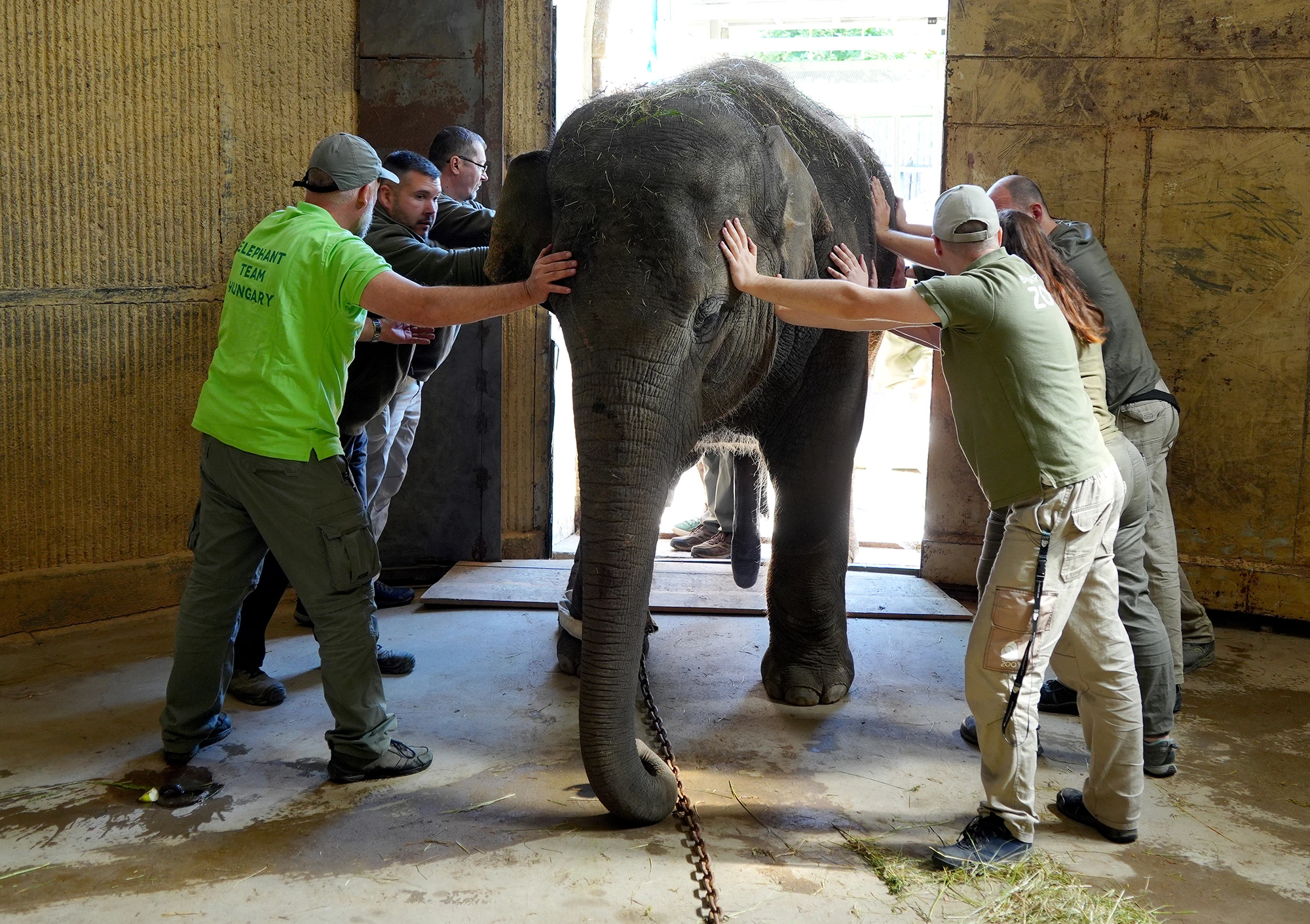
Since yesterday, Samu, the young Asian elephant, has been a resident of the Veszprém Zoo. Of course, we have not been left without elephants, as Samu’s parents, Angele and Assam, can still be seen at our Zoo.
Three calves have been born to our elephant breeding pair so far. Since young elephants, especially males, spend only their early years with their mothers in the wild, it is also standard practice in zoos for them to move to another institution after a certain age. In the wild, elephant herds consist entirely of adult females, while males are present only among the calves. Adult bull elephants live alone and usually meet female elephants only during the breeding season. Young males often leave their mother’s herd and form bachelor groups.
This is reflected in zoo management as well, where young bull elephants are usually transferred to another zoo at around five years of age. Elephant transport requires careful preparation, but in a zoo like ours, where elephant births have become a regular occurrence in recent years, moving young elephants to new homes is also a routine part of our work. Samu’s older brother, Arun, was transferred in 2023 and now lives at the Szeged Zoo.
Samu was born on 24 April 2021 as the third calf of Angele and Assam. At that time, his older brother Arun was still living in Budapest. Footage recorded by a night-vision camera during Samu’s birth shows Arun taking a keen interest in his newborn sibling. Although it may appear in the video that Angele’s first action was to kick the newborn calf, this behaviour is natural in elephants. Mothers do this to help the calf break free from the foetal membranes. If this does not happen, the newborn could suffocate.
During the first few days after his birth, Samu stayed in the indoor facility where he was born. He was first allowed into the outdoor enclosure at three days of age. A video of this occasion shows that the young elephant stayed very close to his mother, while Arun accompanied them, sometimes from nearby and sometimes from a greater distance. The footage also shows several moments when mother and brother stood protectively on either side of the calf as they walked together to the neighbouring enclosure, where Assam, the father, lives.
The young elephant quickly became a favourite among visitors, and we regularly shared videos showing his daily life and how much he enjoyed splashing around in the pool within the elephant enclosure.
Samu was not yet two years old when he faced one of the greatest challenges of his life. He was infected by a dangerous pathogen. Elephant endotheliotropic herpesvirus disease is one of the leading causes of death in young elephants, both in the wild and in zoos. Veterinarians and animal care staff fought tirelessly to save Samu’s life. Their hard work ultimately paid off, and they succeeded in overcoming the disease. Samu made a full recovery and has remained completely healthy ever since.
As Samu approached five years of age, our Zoo’s specialists began planning his future well in advance. For the reasons mentioned above, he could not remain in Budapest long term. Changes in the behaviour between Samu and Angele also indicated that he should move to another zoo during this year. Through the elephant breeding programme coordinated by the European Association of Zoos and Aquaria (EAZA), a new home close to Budapest was selected for him: Veszprém Zoo. The move was announced in April, on Samu’s fifth birthday, by our Zoo’s Director General, Dr Endre Sós, together with László Török, Managing Director of Veszprém Zoo.
Following extensive preparations, the transfer took place on Wednesday, 20 May. Samu first had to be guided into a special transport crate designed specifically for elephants. The crate was then lifted by a large mobile crane onto a specially equipped transport vehicle. The operation required the coordinated work of many professionals, including veterinarians, animal keepers, the crane operator and the transport team. The Budapest Police Headquarters also provided valuable assistance when the 17-metre-long transport vehicle carrying Samu turned onto Zoo Boulevard. The transport convoy was escorted through Budapest traffic by two motorcycle police officers before continuing its journey towards Veszprém via the M7 motorway.
Samu has since arrived safely at his new home in Veszprém. Two of his keepers from Budapest travelled with him to help him settle into his new surroundings. The Budapest keepers are expected to remain in Veszprém until Saturday.