
Thanks to the recently completed modernization, the Great Apes House, home to our gorillas and orangutans, is now more comfortable for the animals and offers more for visitors. A “gorilla language lab” has also been set up in the visitor area.
Keeping great apes at our zoo has a history spanning several decades, and in some cases over a century. Chimpanzees and orangutans were first kept here in the 19th century, while the first gorillas arrived much later, in 1989. Since then, 36 years have passed.
In the past, great apes were mostly housed in the same building as other primates, but as early as the 1970s, the idea arose to create a separate facility specifically for their special needs. This was realized in the 1980s: the current Great Apes House opened in 1987, nearly 40 years ago. In practice, this means that while this building is not as old as most of our other enclosures built between 1909 and 1912, it is still old enough that periodic modernization is necessary. Over the past four decades, several upgrades have taken place, providing the animals with significantly larger indoor spaces and outdoor enclosures compared to 1997.
Most recently, modernization work took place over the past few months, during which parts of the facility were closed to visitors. Some of the improvements focused on the animals: the original ventilation system, dating from the 1980s, was replaced with a completely new, energy-efficient, and very quiet air handling and ventilation system. At the same time, the visitor information system in the Great Apes House was also upgraded to offer more to the public.
With the new, highly visual information system, visitors can now learn more than ever about the orangutans and gorillas living in the facility and its outdoor enclosures, the threats they face in the wild, and how they are cared for at the Budapest Zoo. Part of the system pays tribute to Jane Goodall, the recently deceased world-famous primatologist and conservationist, who visited our zoo multiple times, including the Great Apes House.
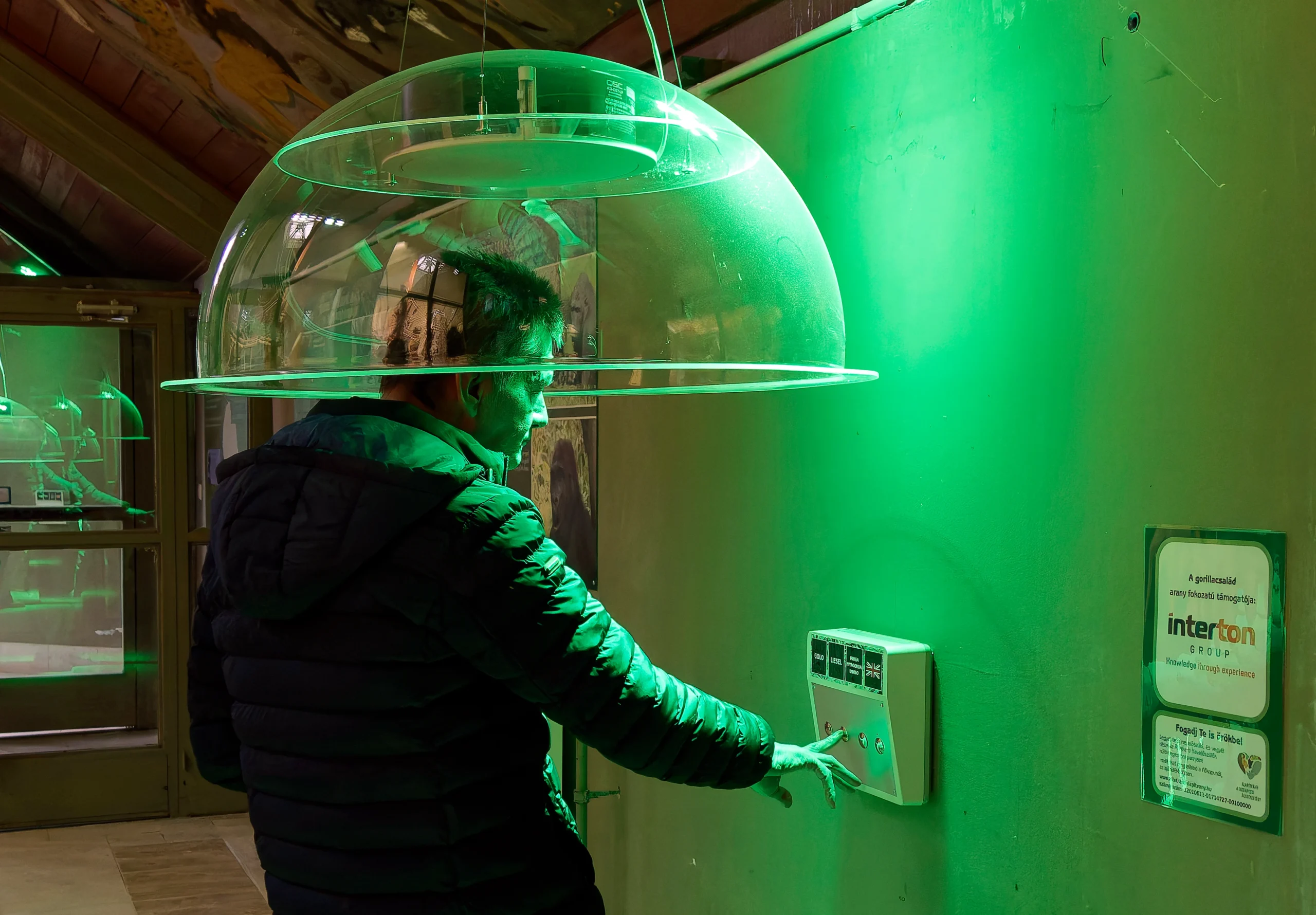
A special feature of the new information system is the gorilla “language lab,” where visitors can listen to the gorillas’ “conversations” with each other. Under plexiglass enclosures in the visitor area, guests can select individual gorillas and hear their vocalizations, along with explanations of what each sound means and in which situations the animals use it. All information is available in Hungarian and English.
The unique gorilla “language lab” was made possible through donations to the Zoo Foundation from the 1% personal income tax campaign. Interton Group was our professional partner in collecting the sounds and setting up the lab. Microphones had to be installed in the gorilla enclosures in a way that would not disturb the animals but also remain inaccessible to the curious primates.
The recordings were made over three weeks, during which Interton set up a small recording studio in the Great Apes House. With the help of experienced keepers, it was possible to identify which gorilla made each sound, the context and emotional state in which the sound was used, and its meaning. In addition to using these recordings for the language lab, the material is also being analyzed for scientific research.
Of course, visitors can occasionally hear gorillas vocalize directly, but this depends on chance, as they only vocalize rarely and usually when indoors, with thick glass separating them from the audience. Therefore, the sounds available under the plexiglass provide most visitors with a completely new experience.
The new information system and gorilla language lab in the Great Apes House were officially opened to the public on December 5 by Dr. Endre Sós, Chief Veterinarian and Director General of the Zoo, Éva Montskó, Chair of the Zoo Foundation, and Géza Balogh, CEO of Interton Group.