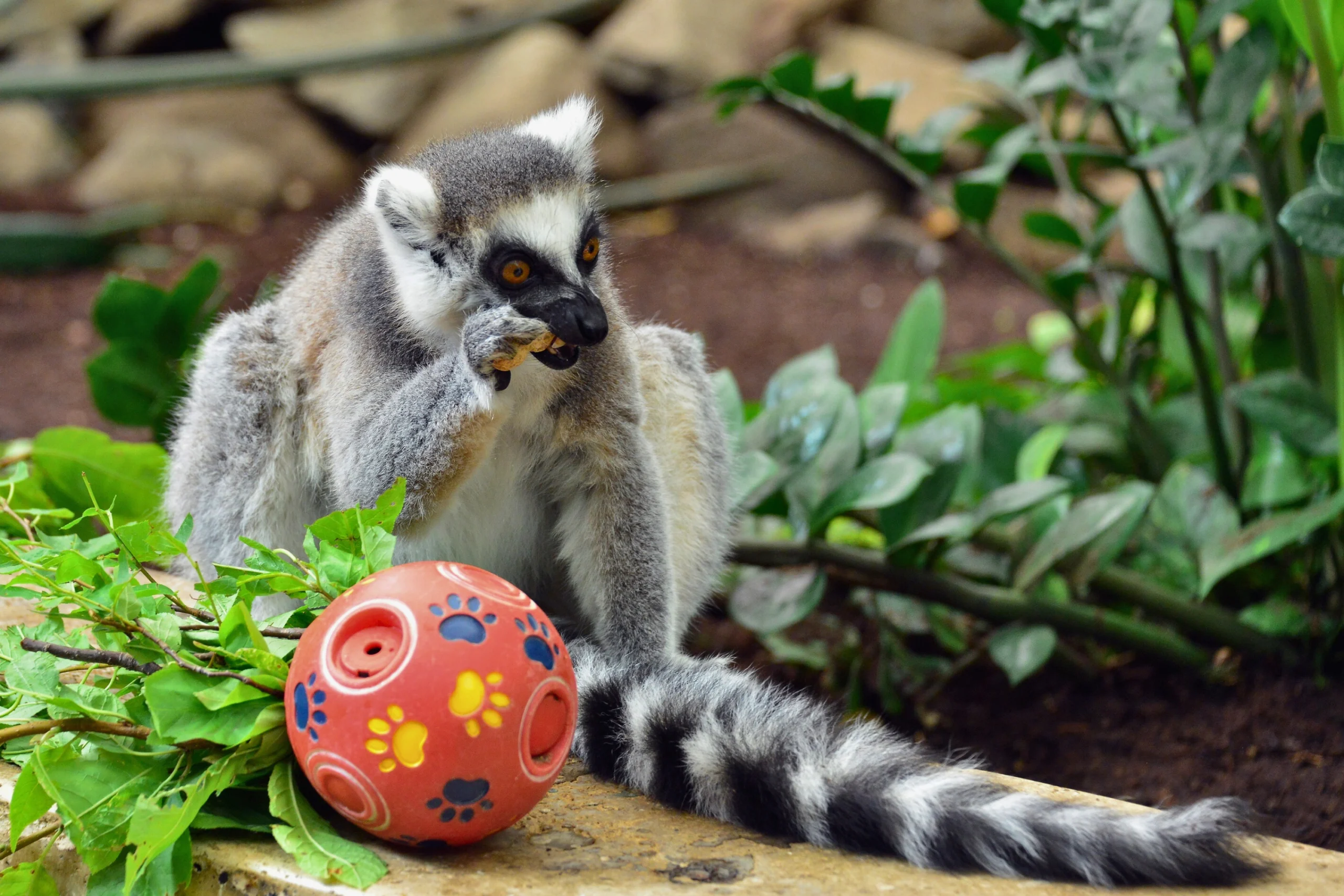
The last Friday of October is a special date in the calendar of animal lovers, as this is World Lemur Day. This year, it falls on 31 October, the same day whose evening is traditionally associated with Halloween.
Historically, Halloween has little to do with lemurs, but it is an interesting cultural fact that the name “lemur”, which comes from Latin and is used in several languages including English, originally meant a ghost, spirit, or restless soul.
The nocturnal lifestyle of lemurs, their often eerie calls, and their eyes that seem to “glow” in the dark (in reality, they only collect and reflect light) have clearly influenced how people have perceived them throughout history. The native people of Madagascar regarded lemurs as embodiments of ancestral spirits, while the first European explorers, hearing the mysterious sounds coming from the forest at night, initially thought that ghosts were moving among the trees. This, and especially the largely nocturnal habits of these animals, led the famous Swedish naturalist Carl Linnaeus to give them the scientific name Lemur.
Within the order of primates, lemurs belong to a group often referred to as prosimians. Three extinct and five living families are known, comprising around one hundred different species. Most of them are active at night, although there are also diurnal species. Many have notably large eyes, allowing them to see relatively well even by moonlight and starlight.
Among lemurs, the best known are the ring-tailed lemurs, also known as kattas. This species is widely recognized in popular culture, partly because of King Julien, a character from the Madagascar animated films, and partly due to a photograph that became an internet meme, typically showing a ring-tailed lemur advising everyone to calm down for one reason or another.
The Budapest Zoo has been keeping and presenting lemurs since its very beginning. When the Zoo opened in 1866, it already housed black lemurs, although at that time they were referred to by an outdated name. Today, we keep three species of lemur: in addition to the ring-tailed lemurs mentioned above, black-and-white ruffed lemurs and red-fronted lemurs also live in our Zoo. Most of them can be seen by visitors in the Madagascar House.