
12 November is Jonah’s Day, which is special for us, as this was the name of our first hippopotamus, who lived in our Zoo between 1893 and 1917. Jonah was already legendary during his lifetime, and for a long time his name was the first that came to people’s minds when they thought of a hippopotamus (until the 1975 animated film Hugo the Hippopotamus).
Although the hippopotamus is native to Africa, this species has been known in Europe for a long time. The great Hellenic thinker Aristotle already wrote about them in his works on natural history, and the Roman author Pliny and other classical writers also mentioned hippopotamuses. It is probably due to Aristotle’s influence that in most European languages the name of the hippopotamus comes from the Greek hippopotamos, meaning “river horse”. This applies not only to the English hippopotamus, the French hippopotame, the Spanish hipopótamo or the Italian ippopotamo, but also to the German Flusspferd and, ultimately, to the Hungarian word víziló, as these are essentially literal translations of the Greek original.
Thanks to the classical authors mentioned above, educated readers in Europe were already aware of the existence of hippopotamuses in earlier times, even though for a long period they had little chance to see such animals alive with their own eyes.
Among European zoos, the first hippopotamus arrived in London in 1850, followed by Paris in 1853, and in the following years the public could also see these animals in Amsterdam and Berlin. Contemporary Hungarian newspapers reported on these events as well.
When our Zoo opened in 1866, it did not yet have a hippopotamus. Visitors had to wait until 1879 to see one, when a Nubian caravan visiting the Zoo during the summer brought, among other things, two live hippopotamuses.
The Zoo acquired its first own hippopotamus in 1893: this was the legendary Jonah. He was probably born in 1881 and became a resident of Berlin Zoo while still relatively young. In the early 1890s, the Berlin Zoo acquired two other hippopotamuses, with whom Jonah did not get along well. As a result, they decided to sell him. Our Zoo obtained Jonah through an animal dealer from Alfeld, a man named Reiche, for 11,500 marks, or 7,500 forints. The Zoo’s first own hippopotamus arrived in spring and was already presented to the public by Easter.
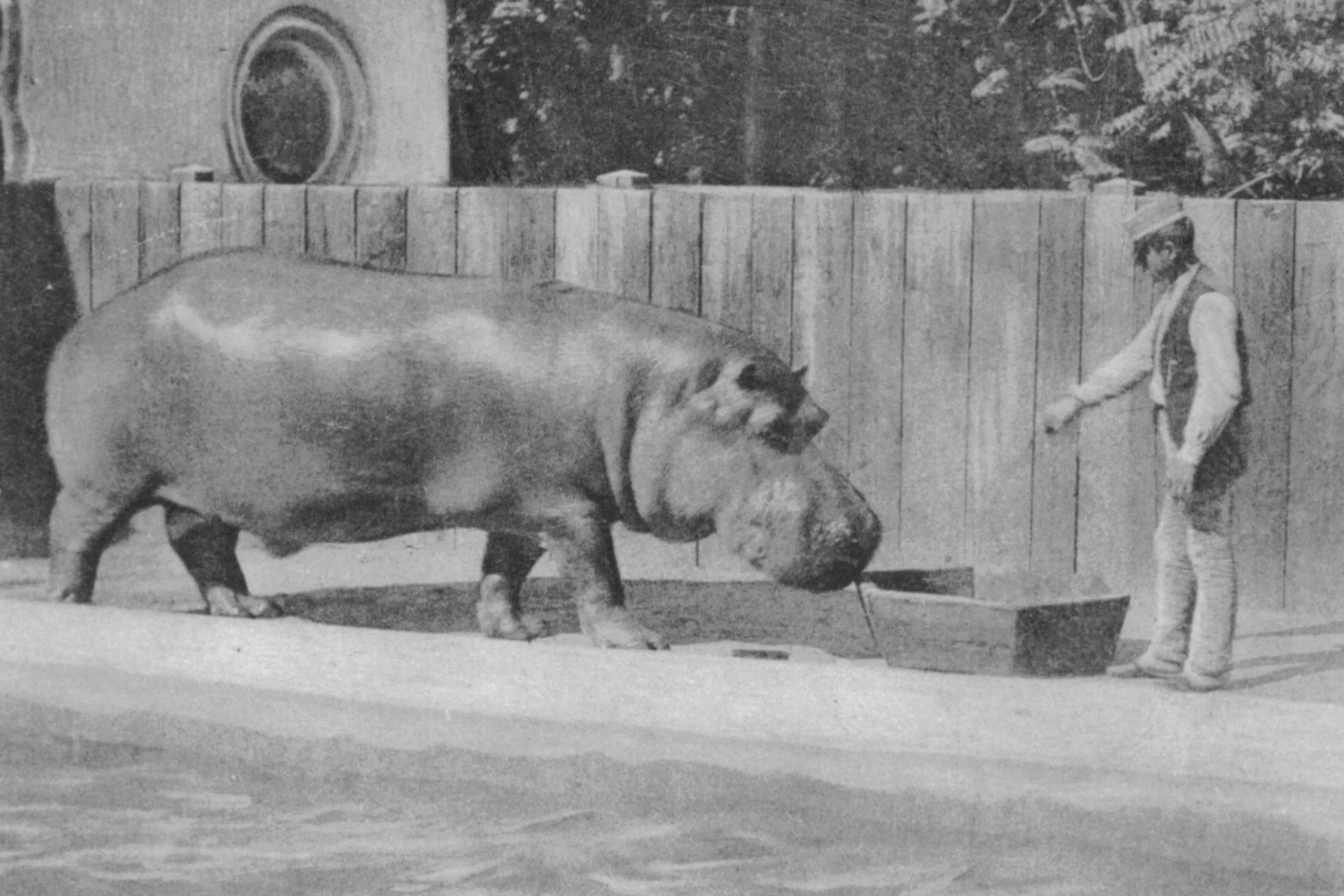
For the large-bodied Jonah, a building originally constructed in 1868 to the designs of Antal Lohr for giraffes and ostriches was converted, as the Zoo had not had giraffes for some time by then. A large pool was also created in the outdoor enclosure belonging to the building. This structure was demolished during the Zoo’s reconstruction between 1909 and 1912, so no trace of it remains today, but it was located roughly in the area between the current hippopotamus enclosure, the flamingos’ summer quarters and the zebra enclosure. Beneath the paving of the walkway leading from the hippopotamuses towards the zebras, the distinctive white side walls of Jonah’s former pool are still present, as the pool was not dismantled during the early 20th-century reconstruction but was simply filled in with soil. Only two photographs of this early hippopotamus facility are known: the image attached to our article, taken in 1894, showing Jonah with his keeper in front of a wooden fence belonging to the enclosure, and another photograph preserved among the images of Loránd Eötvös held by the Hungarian Museum of Science, Technology and Transport.
Jonah soon became the visitors’ number one favourite, a true star. He was also a relatively gentle animal and had an excellent relationship with his keeper. If he spent a longer time in the water but the public wanted to admire him fully on land, the keeper would call out loudly to the already nearly three-ton animal, and Jonah would indeed lumber out onto the shore in the hope of a few tasty treats.
During this period, Jonah had to move twice. The first time was during the Millennium celebrations, when part of the Zoo’s area was leased to the operators of the amusement venue known as Ős-Budavár, and part of the site had to be cleared. The second time was during the major reconstruction between 1909 and 1912, when a new enclosure for the hippopotamuses, including Jonah, was created in the newly built Elephant House. For the move into the new Elephant House, a huge crate was built for Jonah. After the animal had been lured into the crate, it was pushed on rollers laid on the ground to the area where the hippopotamuses can still be seen today. Naturally, the crate with Jonah inside was extremely heavy, so one of the Zoo’s trained elephants, Bébi, also helped with the work.
After the complete reconstruction, which lasted three years, the Zoo reopened in May 1912, and Jonah remained its number one star until his death in 1917. Even after that, he was remembered for a long time, and the name Jonah generally became synonymous with hippopotamuses among the Budapest and Hungarian public. The famous hippopotamus even appeared in Lajos Nagy’s book Képtelen természetrajz (Absurd Natural History), published in 1921:
“The hippopotamus lives in Africa in the Nile, which is why it is also called the Nile horse, although this still does not explain why this fine, pig-like animal is called a horse at all. Anyone who wishes to admire it can see it in our zoo as well, where, among others, an ideal specimen can be found: the charming little fellow named Jonah, the favourite of the women of Pest, who receives piles of love letters every day. Sensitive hearts fall into ecstasy at the very sound of his name, at this touching, heart-stirring word: Jonah. It is the most suitable name for a young hippopotamus. Our further suggestions are: Adalbert, Döme, Bódog, Icig and Alajos; for female hippopotamuses: Eulália, Sarolta, Ludmilla and Ibolyka.”