
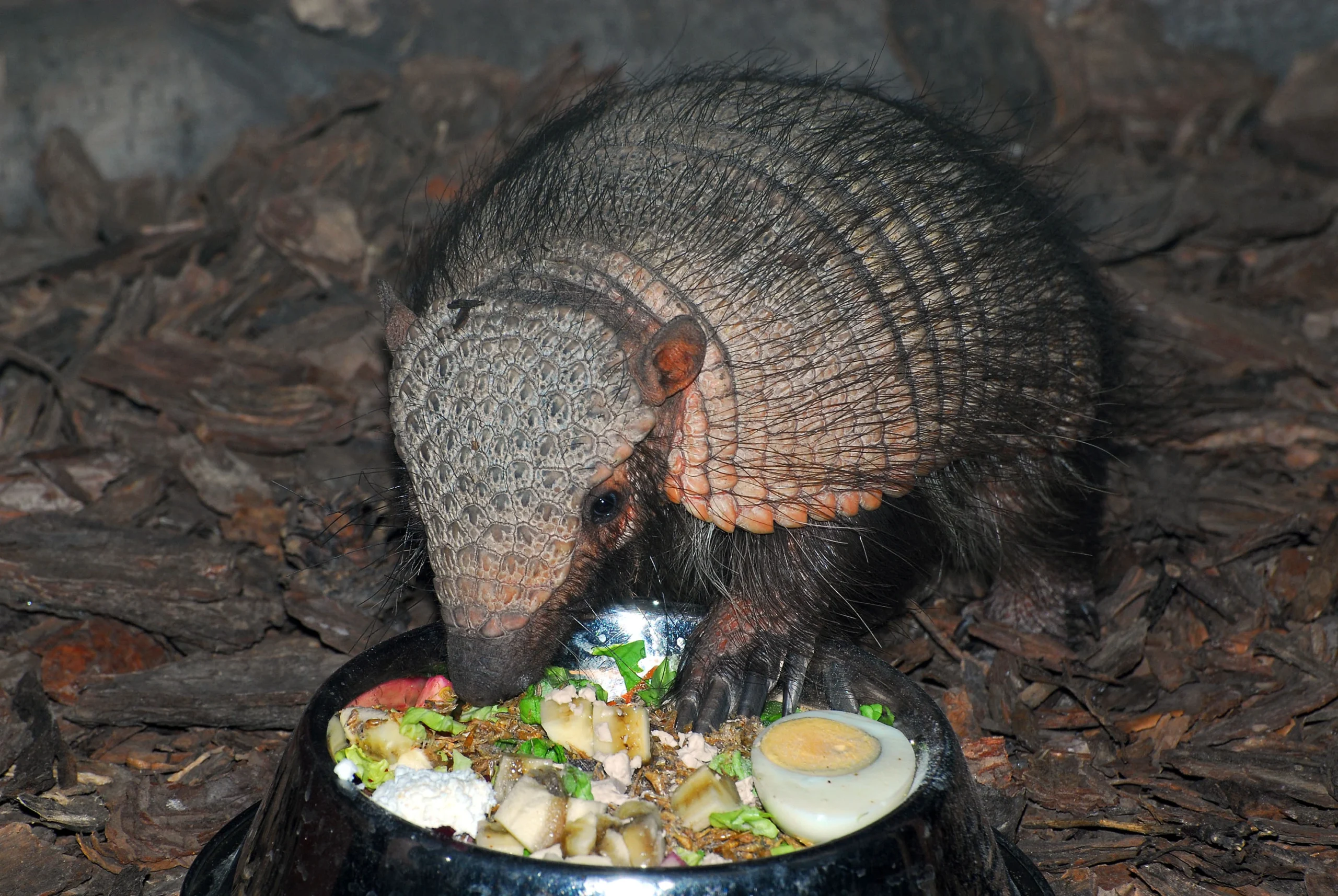
In the Zoo’s feeding kitchen, officially called the Nutrition Center, there is a lot of activity early in the morning. The shift starts at 6 a.m., meaning the food preparation staff begin work one and a half hours before the keepers. This early start ensures that the day’s food is ready in time and delivered to the various animal houses around 8–9 a.m. The crates are filled one by one with a wide range of items: apples, bananas, carrots, cheese, cocktail shrimp, or even monkey biscuits. The portions prepared for each animal house are then loaded onto an electric delivery truck and transported to the Zoo’s different locations, where the assigned keepers complete the feeding process. These keepers know not only what an elephant, tiger, or hyacinth macaw generally eats, but also each individual’s preferences and any special dietary requirements.
To fully understand what happens in the Zoo’s feeding kitchen, we need to start at the beginning: why we feed the animals. The obvious answer is that otherwise, they would starve. While this is true, the main point is that animals need nutrients. These nutrients help build and maintain their bodies, even in fully grown animals, replacing lost skin cells, hair, or feathers. Food also provides the energy needed for body functions. So, consumed food serves both as building material and fuel. The nutritional value of food is expressed in terms of energy content, usually in joules (J), kilojoules (kJ), calories (cal), or kilocalories (kcal) per unit of mass. Most people have seen these values on food packaging.
Humans have kept and fed animals for thousands of years. Most of these were farm or domestic animals, fed based on experience, sometimes well, sometimes poorly. With the advancement of science, feeding became a science in its own right. Nutritional science uses chemistry, physics, anatomy, physiology, and even botany to study how animals use nutrients, to examine the feed itself, and to develop rational feeding methods.
Keeping wild animals has a history roughly as long as domestic animals, and even ancient Eastern civilizations had menageries housing large numbers of wild and sometimes exotic species. Therefore, feeding wild animals also has a long history. However, feeding zoo animals has only become a fully developed science in the last hundred years.
Feeding a zoo animal starts with understanding what it eats in the wild. There is great variety: some are herbivores, some carnivores, and some omnivores. It is even more complex, as “carnivore” can mean a tiger hunting deer, a giant otter eating fish, a whale feeding on tiny drifting organisms, or a bat catching mosquitoes in flight. Among mammals alone, specialists recognize 16 different feeding strategies.
Animals are adapted to their food in terms of body shape, mouth or beak, teeth, digestive system, and behavior. A grazer, a fruit- or seed-eater, an active predator, a scavenger, or a filter-feeder all face very different challenges. Zoo feeding must take these adaptations into account, not just what is fed, but how it is presented and how the animal can access it.
In the early days of zoos, animals were fed based on similarities to domestic livestock. Large antelopes were fed like cattle, zebras like horses. But some animals, like the giant anteater or the binturong, had no direct domestic counterpart. Later, feeding evolved mostly through trial and error, sometimes influenced by beliefs. For example, early zoo gorillas—whose imposing appearance suggested they might be dangerous—were often given meat, even though they are peaceful herbivores.
From the 1890s, more detailed observations of zoo animal feeding were recorded and shared internationally. Broader scientific studies began after World War I. One of the earliest publications on zoo animal nutrition was by our former director Csaba Anghi, published in a German-language journal just before World War II.
Although wild diets guide zoo feeding, animals usually do not eat exactly the same foods in captivity. Lions, for example, do not require antelopes or zebras; farmed meat suffices. Zebras do not need specific African grasses—they thrive on quality Hungarian hay. Seals and penguins, however, require marine fish and will not eat freshwater fish. Wartime and postwar periods posed challenges, as marine fish supply was disrupted. After World War II, with no surviving seals, we initially kept freshwater species, and only by 1966 did we have a stable supply to exhibit California sea lions.
It is not enough to know what each species needs; the food must also be procured and supplied daily. This work is handled by our nutrition team. Purchased feed, produce, and food are stored in the Nutrition Center’s warehouses, fridges, and freezers, from which the kitchen staff prepare the portions for each animal house.
Currently, the Zoo’s shopping list includes around 300 types of feed. Based on 2024 consumption: 54.5 tons of carrots, 6 tons of beets, 63 tons of apples, 11.7 tons of bananas, 5 tons of oranges, 1,546 kg of pineapple, 1,509 mangoes, 335 kg of raisins, 491 tons of meadow hay, 80 tons of alfalfa hay, 195 tons of green alfalfa, 3,450 corn cobs, 25 tons of corn stalks, 19 tons of raw meat, 4 tons of beef hearts, 276,600 crickets, 82,290 locusts, 8.9 tons of marine fish, 342 kg of cocktail shrimp, 179 liters of tubifex worms, 1,530 kg of cheese, and 837 kg of anteater feed.
Naturally, many wonder about the cost. Considering food and feed prices in recent years, it is substantial. On an average day, feeding the animals costs around two million forints.
Alongside photos of the current feeding work, our article includes archival images. These show a donkey-drawn meat cart from the interwar period and a grain master distributing feed from the warehouse. The archives also provide a glimpse into the old feeding kitchens as they appeared in 1963 and 1973.