When the area of our Zoo was designated in 1864, it covered 18 hectares. Over the first nine decades, it gradually decreased to 10.8 hectares, then remained unchanged for more than fifty years. Only recently have we been able to acquire new areas, so today our grounds once again cover 18 hectares. These changes are linked to a series of eventful developments, which we present in this article.
This year marks the 160th anniversary of our Zoo, and to celebrate this milestone, we have declared the entire year of 2026 a jubilee commemorative year. As part of this, we regularly publish content about the Zoo’s history on our website. This time, we take a closer look at how the size of the Zoo has changed over time.
This is especially noteworthy because, while most zoos—both in Hungary and abroad—have traditionally expanded their original areas over time, our Zoo is quite unique in that its grounds were not expanded in the past but were instead reduced on several occasions. The last such reduction took place in the 1950s. After that, the area remained unchanged for more than half a century, and only in recent years have we been able to partly compensate for the earlier losses. As a result, our Zoo is not considered particularly large, either by international or domestic standards.
The land where the Zoo and City Park are located today was owned by the Becsi family during the Árpád era. After the Mongol invasion, it became the property of the Dominican nuns of Margaret Island. Following a lengthy legal dispute, the city of Pest became the owner of the area—then known as Ökördűlő—in the mid-18th century.
By 1864, when the Zoo’s area was designated, City Park had already existed for some time. Tree planting had begun more than a century earlier, and more extensive landscaping had been underway for about fifty years, with some interruptions. However, the part of the park near the railway was not yet properly developed and even included a tree nursery. It was here that the municipal authorities of Pest designated an area of 31 cadastral holds and 600 square fathoms for the establishment of a zoo. In today’s units, this corresponds to approximately 18 hectares and also included part of the area around what is now the Széchenyi Thermal Bath.
The original plan was to reserve a small portion of this land for future development, while the larger part became the Zoo itself, which opened to the public on 9 August 1866. Later, however, the reserved land was taken away, and additional sections were also removed from the Zoo when the Zoo Boulevard was built in place of an earlier promenade, but at a much greater width.
The reduction of the Zoo’s area continued in 1907, when a large parcel was cut off from the Hermina Road side. The reason was that the fairground operators, who had previously occupied the area where the Széchenyi Thermal Bath now stands, had to relocate due to the construction of the bath. They were given space at the expense of the Zoo. In return, carousel operators such as Schäftner and Klupáti, the shooting gallery operator Pöltl, the photographer Helfgott, and other tenants of the fairground paid their rent to the Zoo until the end of the Second World War. The same applied to the circus, whose plot was also taken from the Zoo. The principle at the time was that the entire area should serve the Zoo’s purposes: the main part by hosting the Zoo itself, and the circus and fairground areas by generating rental income for the Zoo. However, this principle was no longer followed after the war.
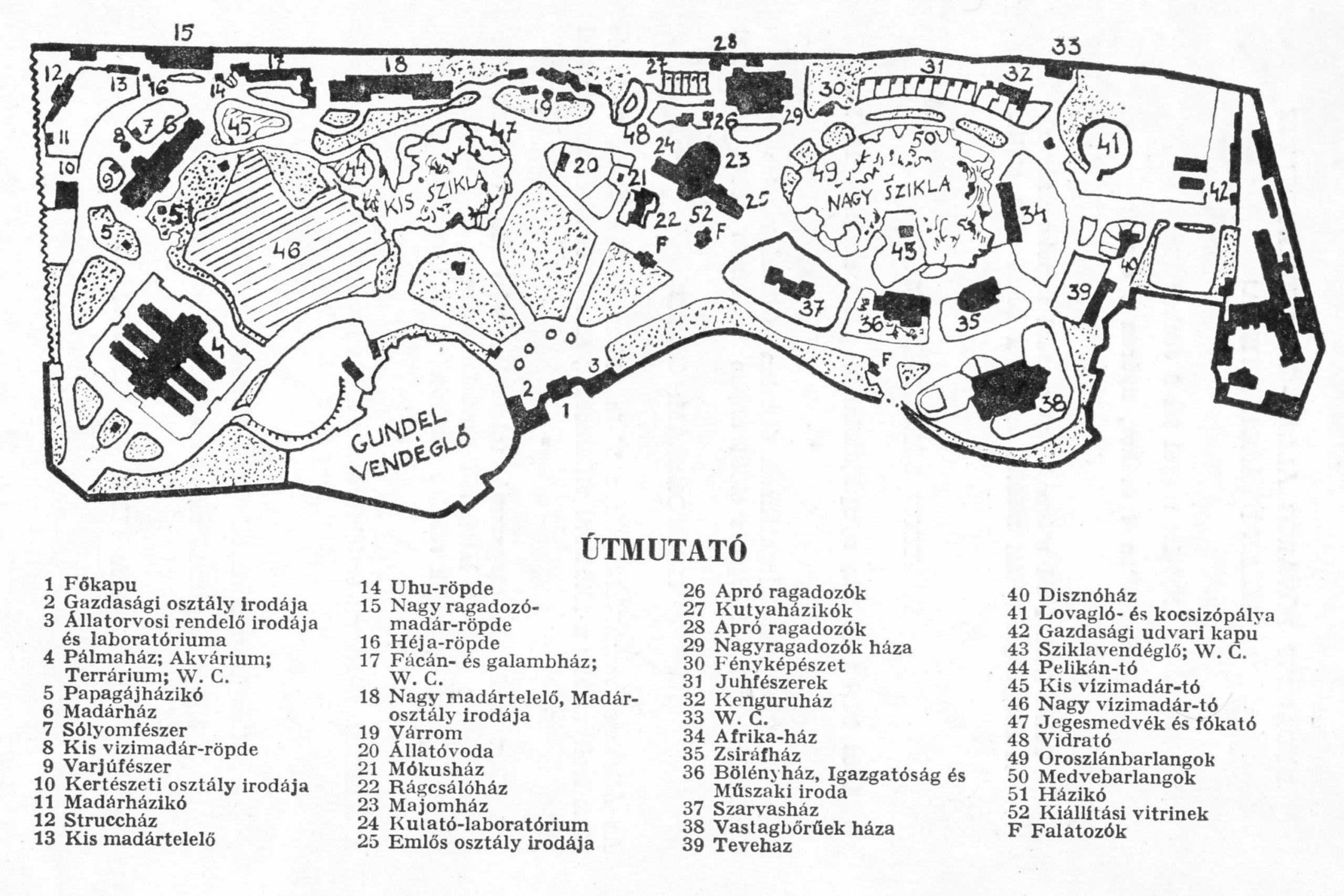
The last major reduction took place in the 1950s, when the fence along Dózsa György Road was moved several metres inward along its entire length to allow for the widening of the road and the underpass beneath the railway—again at the expense of the Zoo. As a result, the original 18 hectares designated in 1864 shrank to just 10.8 hectares, and this remained essentially unchanged until 2014.
Over the past decade, several steps have been taken to regain areas and offset earlier losses. Although the Zoo has not become particularly large, the current area of around 18 hectares once again provides a meaningful space for the public service work we carry out every day—from education and environmental awareness to nature conservation.