
December 9 is World Veterinary Day, which highlights the importance of veterinary medicine, veterinarians, and animal health professionals worldwide. On this occasion, we briefly look back at nearly 160 years of veterinary work at our Zoo.
When the Budapest Zoo and Botanical Garden first opened its doors in 1866, zoo veterinary medicine was still in its infancy globally. Veterinary science itself existed, but it initially focused mainly on maintaining the health of horses for military purposes and controlling outbreaks like cattle plague. In Hungary, higher-level veterinary training began as early as 1787 at the predecessor of today’s University of Veterinary Medicine, making it one of the earliest programs in the world. However, exotic zoo animals were largely absent from veterinary science, so in the 1860s very few zoos anywhere had a dedicated veterinarian.
At our Zoo, veterinary and animal health work started in the early 1890s. The Zoo did not yet have its own veterinarian, but Ferenc Hutÿra, a pioneering and highly skilled veterinarian, regularly treated sick animals. The first major success came in 1892 when a lioness became ill in January and refused to eat for 17 days. Dr. Hutÿra’s treatment eventually worked, and the lioness fully recovered.
After the City of Budapest took over the Zoo in 1907, a permanent veterinarian was appointed, and in the same year an animal doctor, Zoltán Rátonyi, was also named director. Following the Zoo’s reconstruction between 1909 and 1912, with Adolf Lendl as director, Emil Raitsits became the Zoo’s veterinarian. Raitsits oversaw animal health until the early 1930s, after which Lajos Abonyi took over. Post-World War II, the role was filled successively by Jenő Lépold, István Dózsa, and Géza Póka. During the 1970s, 80s, and 90s, veterinary duties were handled by Lajos Fábián, András Balsai, Zoltán Graf, László Horváth, László Mezősi, and István Hill.
Early veterinary care for zoo animals was very limited. Knowledge about the anatomy, physiology, nutrition, and diseases of exotic species was scarce. Treatment options were very different from today, considering that antibiotic research only began in the early 20th century, penicillin was discovered in 1928, and broader use of antibiotics followed later, first in human medicine and then, with some delay, in veterinary medicine.
A major challenge was accessing wild animals for diagnostic examinations or treatments. In the early days, lassos, restraints, ropes, chains, and stocks were used, which were often far from ideal. Later, movable-walled examination cages were tested, where animals were lured in and gently restricted with adjustable panels. Such cages were still in use at our Zoo during the 1950s and 60s. These solutions were far from perfect, often risky, and stressful for the animals.
The introduction of remote injection equipment provided a solution. Initially, homemade tools like syringes on sticks were used, which later evolved into dart guns. Tranquilizer guns and blowpipes were also introduced. At our Zoo, experiments with these devices began in the late 1950s, initially in pistol form. Over the past half-century, these tools have developed significantly, as have anesthetics and active substances. Diagnostic equipment has also improved. The Zoo acquired an X-ray machine in the 1970s, and today we also have modern ultrasound devices and, if needed, access to MRI for diagnostics.
Today, our veterinary team consists of five veterinarians and two assistants. Their leader, Dr. Endre Sós, is Chief Veterinarian, Zoo Director, and a university lecturer at the University of Veterinary Medicine. He also holds leadership roles in the Hungarian Association of Zoo and Wildlife Veterinarians (MVÁÁT), the Hungarian Association of Zoos and Aquariums (MÁSZ), and the European Association of Zoo and Wildlife Veterinarians (EAZWV), serving as president from 2023 to 2024.
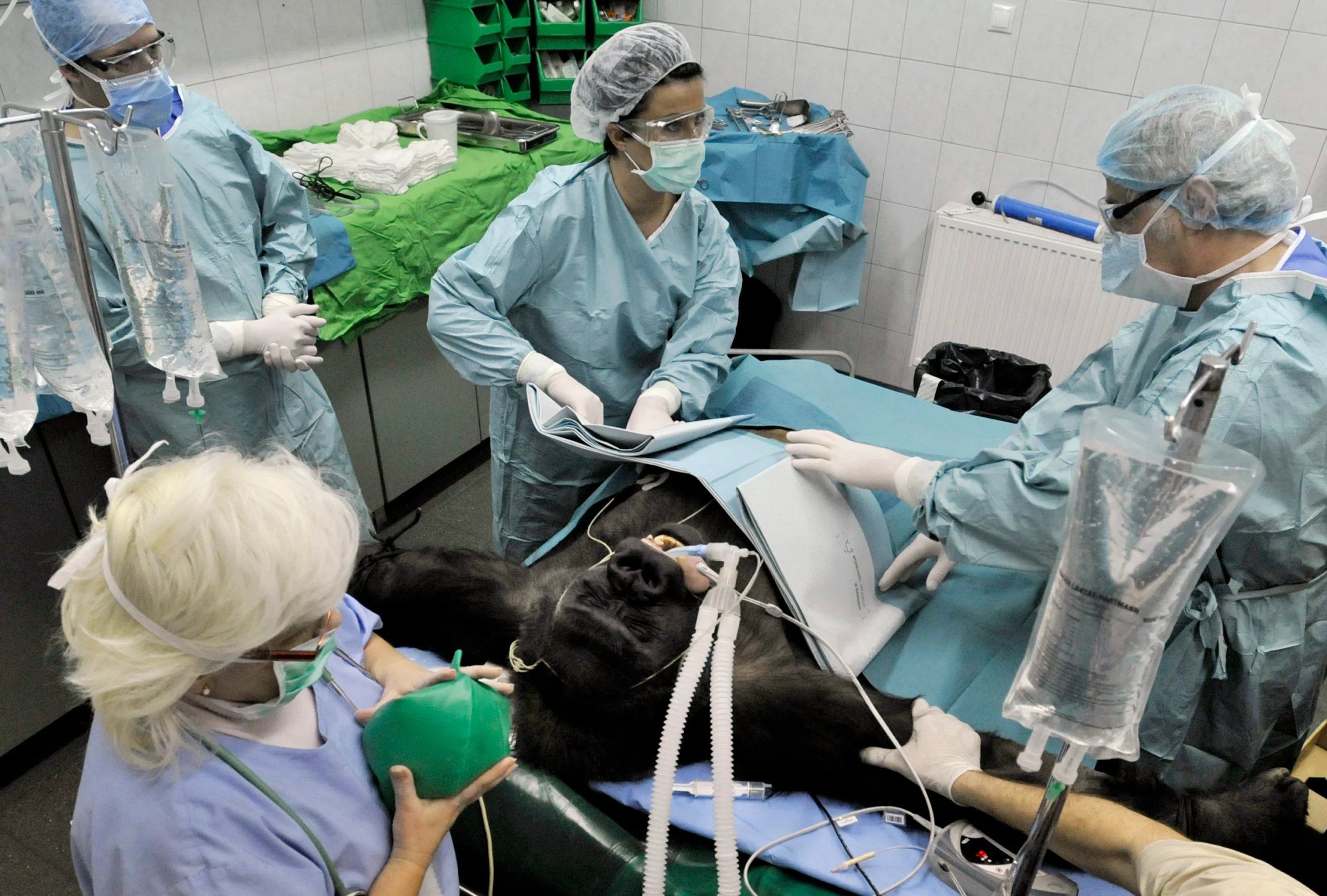
Protecting the health of zoo animals is a team effort. The veterinary team works closely with animal health staff, nutritionists, and technical experts. External specialists are sometimes involved, for example, human medical specialists assist in gorilla surgeries.
The Zoo’s veterinary team also collaborates closely with the University of Veterinary Medicine. The Zoo’s Department of Zoo Animal Health functions as an external department of the university and serves as a key research and teaching center for Hungarian zoo and wildlife veterinary medicine, playing an important role in undergraduate, specialized veterinary, and international student training.