Everyone knows that in zoos around the world it is customary to place signs at animal enclosures and exhibits indicating which species live there and the most important information about them. This has also been the case in our Zoo for the past 160 years. Naturally, this practice also has its own history. In this article we take a look at how it developed over time.
Friends of our Zoo already know that we have declared the year 2026 a jubilee year. This year we celebrate our 160th anniversary. The actual birthday will be in August, but throughout the year we are preparing various programs connected to the anniversary. We will also regularly share stories and interesting facts about the history of the Zoo on our website. This time we focus on how the educational signs placed at the animal enclosures have developed over the years. As with everything in our Zoo, these signs also have their own history.
In every zoo it is natural that a sign at the enclosure tells visitors exactly which animal can be seen there. Such species name signs have been present in our Zoo since the very beginning, starting with the opening in 1866. In the early days these were elegant porcelain signs. However, apart from the Hungarian and scientific (Latin) name of the species, and sometimes the indication of its native range, they usually did not contain additional information. Later, enamel signs and signs painted on metal or wooden boards became common, but the information displayed on them remained the same. Visitors who wanted to learn more about the animals could buy a guide booklet or read the Zoo’s newspaper for more detailed information. These painted signs were made by a sign painter, a craftsman who also produced company signs and shop window lettering.
From the mid-1950s onwards, the educational role of the Zoo became much more strongly emphasized. This change was largely thanks to Csaba Anghi, who was appointed director in March 1956. This shift in approach also affected the signage, and a development process began in which the signs placed at the enclosures gradually started to include more information.
As a first step, the value of certain animals expressed in Hungarian forints was displayed on the species signs, mainly for more valuable mammal species. This information was intended to strengthen visitors’ sense of responsibility. At that time several valuable animals had died because of visitor negligence. The idea was that if visitors understood the financial loss caused by irresponsible feeding or by throwing dangerous objects into the enclosures, they might behave more carefully and such incidents would become less frequent.
The next step was the creation of species information boards that not only displayed the name of the animal but also provided more detailed information, often supplemented with a map showing the species’ natural distribution. In addition, more large thematic boards were installed, presenting specific topics in greater detail, often with diagrams illustrating the evolutionary relationships between different animal groups.
Between 1956 and the early 1960s these boards were designed by the well-known painter, graphic artist and art teacher Aladár Fáy. The artist, who had been an important figure in the so-called folk movement, had been imprisoned by the communist authorities. After his release in 1954 he was unable to find work as an artist or teacher. Professor Anghi, however, remembered him from the 1930s as an artist who had shown a strong interest in zoo animals, and gave him work as a sign painter. His artistic illustrations created for the Zoo’s boards are still worth seeing today. While working at the Zoo, Fáy was even able to publish again, although this had previously been forbidden to him. For example, he wrote about how zoo enclosures can be designed so that the animals remain clearly visible.
In the 1970s enamel metal signs became popular, and we used them until the mid-1990s. The only difficulty was that they were not easy to produce, and it was not practical to order new enamel signs individually when a species not previously kept in the Zoo arrived. From the 1980s onward, the signs for new species were therefore labeled using the so-called Letraset technique. During this period the Zoo’s graphic artist at the time, Mihály Lupták, also created excellent color illustrations, for example about the different families of rodents and their evolutionary development. “Uncle Misi,” as many called him, was also a talented painter and illustrated educational books, including the volume Prehistoric Animals in the Búvár Pocket Books series.
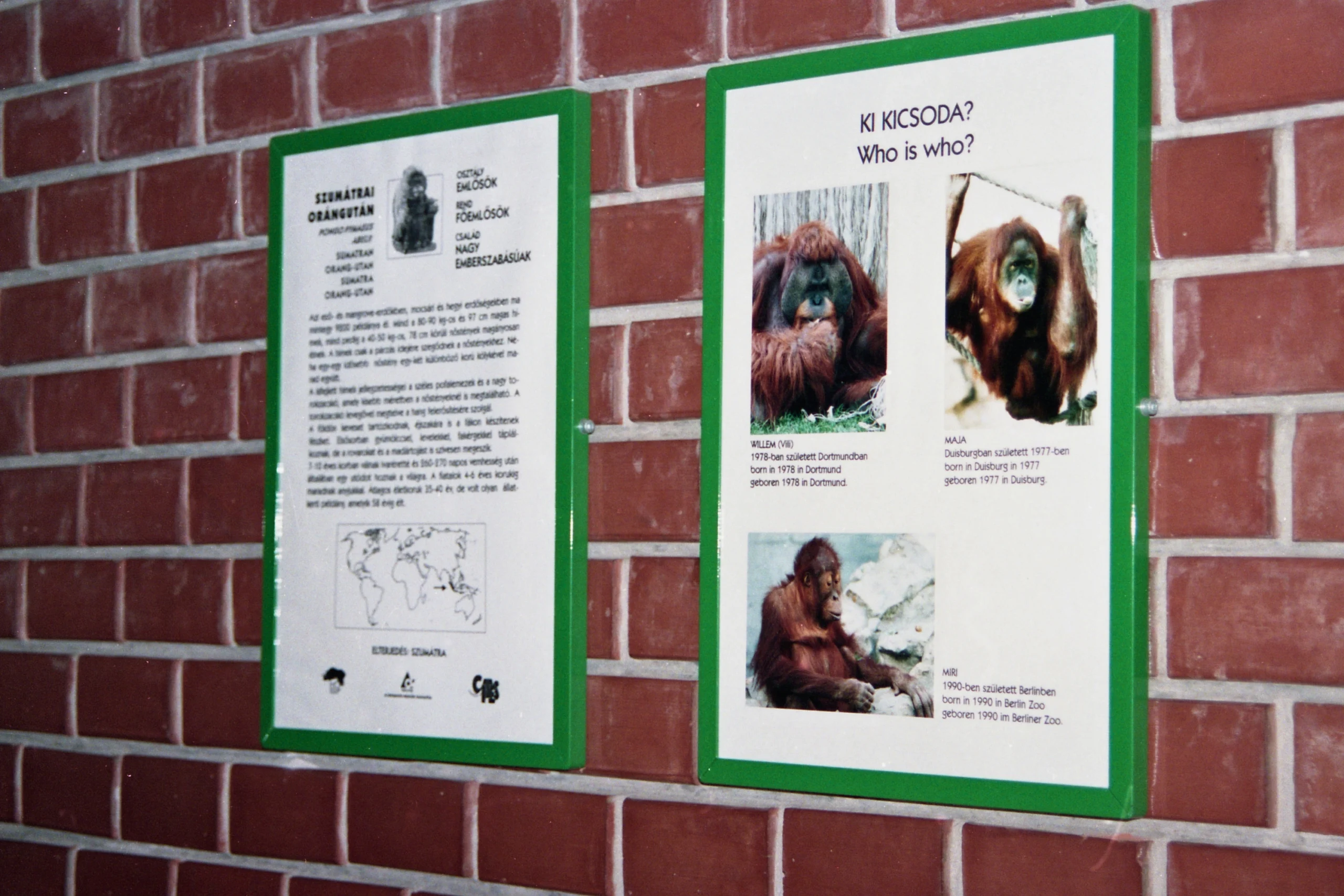
From the 1990s we increasingly began using computer-designed species information boards printed on laminated paper. At first these appeared alongside the older enamel signs and the Letraset boards, which created a rather mixed and somewhat unstructured overall appearance. For this reason, in 1996 we introduced a completely new and unified sign system: laminated sheets were placed in uniform green metal frames. This was still not the system used today. The current species information boards have been in use since 2007.
Naturally, we also have larger thematic boards that use images and text to share additional information about the animals, their way of life, their physiological characteristics, their natural habitats and the threats that endanger their survival. The visual design of these boards usually matches the given animal house or exhibition area.
People primarily visit zoos to relax and enjoy new experiences. At the same time, education and raising awareness are also important parts of our work, and there are many ways to achieve this. Visitors can learn from training sessions, animal feedings and other experience programs, as well as from the information displays placed near the enclosures and inside the animal houses. Our aim is that when visitors leave the Zoo after an enjoyable visit, they always know a little more about the living world than when they arrived.