
The Urban Oasis opened in the Biodome on 1 July. This approximately one-hectare indoor exhibition area welcomes visitors with lush tropical and subtropical vegetation, fascinating animals, including species not seen at our Zoo for decades, and around thirty realistic, life-sized prehistoric reptile models.
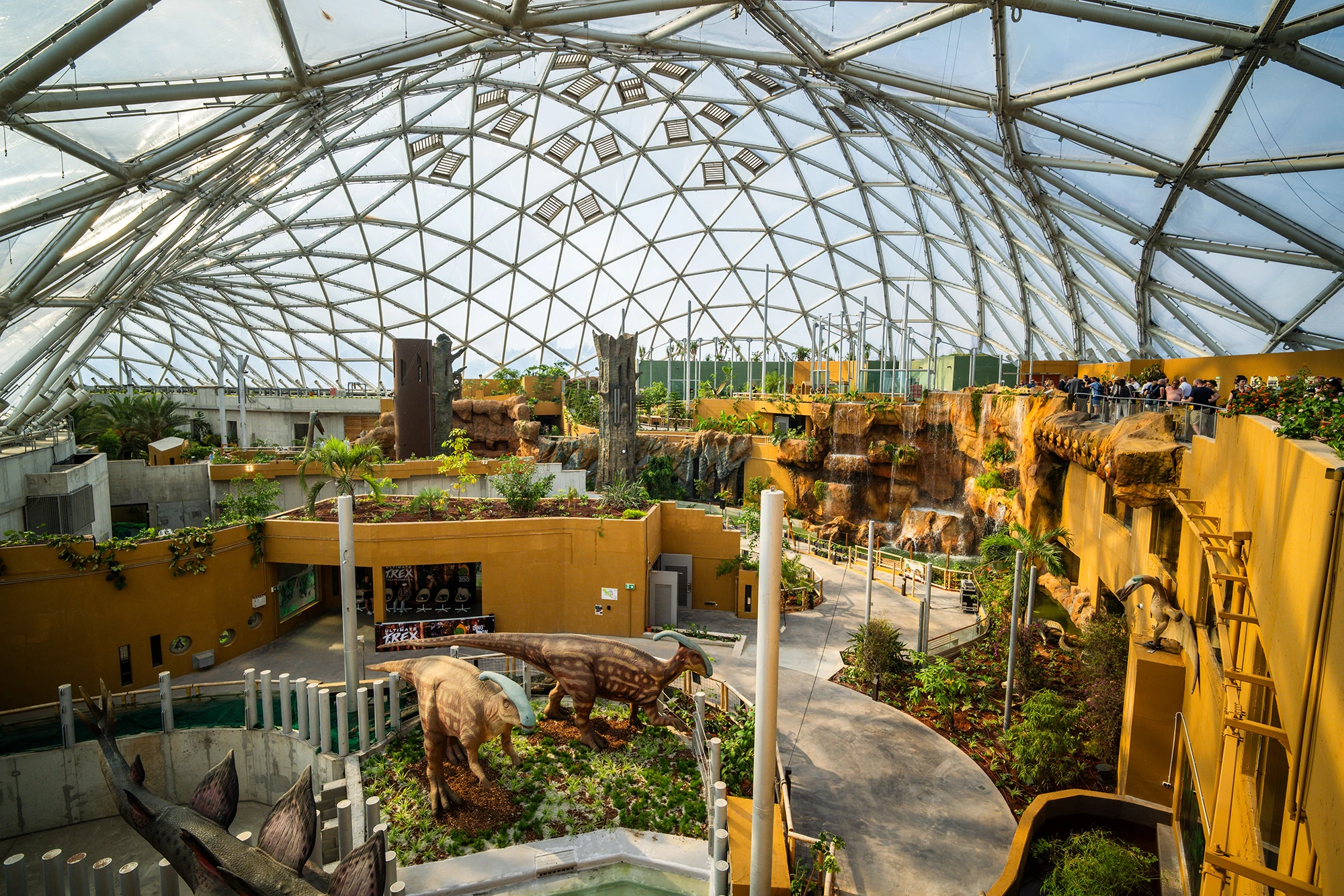
The Urban Oasis is now open to visitors and has been created in the central hall of our Zoo’s Biodome. Its opening hours follow the schedule of the Zoo’s other animal houses. As promised, no separate ticket is required for the Urban Oasis. It can be visited with regular Zoo tickets and passes, just like any other part or animal house of the Zoo.
The official opening of the Urban Oasis took place on Tuesday afternoon, 30 June. The facility was opened by László Gajdos, Minister responsible for the living environment, Gergely Karácsony, Mayor of Budapest, and Dr Endre Sós, Director General of our Zoo. A delegation from the Embassy of the Republic of Indonesia in Hungary also attended the event.
On Wednesday, 1 July, the general public could also visit the Urban Oasis for the first time. Before the opening, families could take part in a quiz game, followed at 10 a.m. by a round-table discussion about the Biodome building. The participants included the three lead designers, Dr Gergely Paulinyi, Dr András Reith and Dr Anthony Gall, as well as Dr Endre Sós, Director General of the Zoo. The discussion was moderated by Gábor Gundel Takács. At 11:15 a.m., the participants of the discussion switched on the Biodome waterfall together.
One of the most interesting species presented in the Urban Oasis is the Hanuman langur (Semnopithecus entellus). This species, native to South Asia, including India and Bangladesh, is declining in the wild. Therefore, the European Association of Zoos and Aquaria (EAZA) operates a breeding programme to coordinate the conservation breeding of the species in zoos. The Hanuman langurs in the Biodome recently arrived from the Czech Republic and Bulgaria as part of this programme. These monkeys are also important from a cultural and historical perspective: in India, they are associated with Hanuman, the sacred monkey-headed and monkey-tailed figure of Hindu religion, and they also appear in Rudyard Kipling’s famous collection of stories, The Jungle Book. Visitors to Budapest Zoo last saw Hanuman langurs 74 years ago.
Another special species is the critically endangered Bali myna (Leucopsar rothschildi), which in the wild is found only on the Indonesian island of Bali, mainly in a national park in the western part of the island. The wild population is estimated to consist of fewer than 50 individuals, making zoo breeding efforts especially important. For this reason, a European zoo breeding programme has also been established for this species. Bali mynas were previously kept at Budapest Zoo, but after a break of more than 15 years, visitors can now see them again.
The Palawan peacock-pheasant (Polyplectron napoleonis) is also known as the Napoleon peacock-pheasant. The first name refers to the fact that this bird species is native to Palawan, an island belonging to the Philippines. The second name comes from the French naturalist René Lesson, who described the species for science in 1831 and greatly admired Napoleon, who had already been dead for a decade at that time. The species is declining in its natural habitat, and the International Union for Conservation of Nature (IUCN) classifies its conservation status as Vulnerable.
The Luzon bark rat (Phloemys pallidus) is also native to the Philippines, specifically the northern and central regions of Luzon Island. It belongs to the order of rodents and the family of mice and rats. Weighing 2–3 kilograms, it is actually one of the largest members of this family. Due to its distinctive fur and colouring, it somewhat resembles a giant panda plush toy. Its fur has a fruity, musky scent which, although not particularly unpleasant, may help confuse predators. This animal spends most of its time among tree branches. Its clawed toes make it well adapted to climbing tree bark, which is why it received the name bark rat.
In addition to these species, visitors can see several other interesting animals in the Urban Oasis, including the endangered Sakishima grass lizard (Takydromus dorsalis), the Vulnerable Henkel’s flat-tailed gecko (Uroplatus henkeli), which is native only to Madagascar, and the African spurred tortoise (Centrochelys sulcata), considered the third-largest land tortoise species in the world.
The main character of the Urban Oasis is its lush vegetation. Almost one third of the one-hectare visitor area is covered with plants (the total planting area is exactly 2,950 square metres). The Biodome was designed from the beginning to allow plants to be placed in its central hall. During construction, 276 cubic metres of foam glass drainage material and 1,740 cubic metres of special growing medium (soil suitable for tropical plants) were brought into the 150 planting beds created inside the building. The latter amount corresponds to the transport capacity of 70 semi-trailers pulled by tractor units.
Planting began in 2021 with palm trees that had “retired” from the film industry. The large Canary Island date palms (Phoenix canariensis) and date palms (Phoenix dactylifera) now seen in the Biodome were originally used as set decorations for the Marvel Studios miniseries Moon Knight, partly filmed in Hungary, and were later given to the Zoo. Transporting these large palms into the building was a major logistical challenge.
The plants introduced into the Biodome come from several different sources. Some were donated by private individuals: mostly well-cared-for plants that had simply outgrown their homes or stairwells and can now continue growing in a spacious environment. Others were newly purchased, with 11.5 million forints spent on acquiring plants. However, a significant part of the Biodome’s plant collection was propagated and raised by the Zoo’s gardeners themselves over the past five years, with the Biodome’s planting plans in mind. The value of these plants, grown in the Zoo’s nursery and transferred to the Biodome, is close to 50 million forints.
Alongside many living animals and plants, visitors can also see prehistoric creatures in the Biodome. More than thirty realistic, life-sized models of dinosaurs and other prehistoric reptiles help bring the ancient past to life. Many of them can also move. For many decades, the Zoo has aimed to present the animal world of prehistoric times in some form. The Magic Mountain exhibition area, opened inside the Great Rock in 2012, also includes a section dedicated to prehistoric life. In addition, the Biodome already hosted a very successful prehistoric exhibition in February and March 2025, which attracted more than 47,000 visitors. The great interest in the previous exhibition encouraged us to include prehistoric life in the Urban Oasis as well.
The largest prehistoric model on display is a life-sized reconstruction of a Brachiosaurus, measuring 25 metres in length and almost 12 metres in height. Well-known and popular prehistoric animals are also represented, including the predatory Tyrannosaurus, the plated Stegosaurus and the distinctive-crested Spinosaurus. The reconstruction of Quetzalcoatlus is particularly impressive: this giant flying reptile may have had a wingspan of around 12 metres.
The organisers also paid special attention to including Hungarian dinosaurs in the exhibition. Visitors can see, for example, a reconstruction of Hungarosaurus, whose remains were discovered by Hungarian palaeontologists near Iharkút in the Bakony Mountains. We also share more interesting facts about Hungarian dinosaurs, and children can try out how palaeontologists excavate fossils.
In one of the Biodome’s corridors, visitors can also enjoy the photo exhibition titled Our Invisible Reality. The exhibition presents special photographs taken by Ágnes Berentés, geologist, geographer and cave photographer, under ultraviolet (UV) lighting, displayed on interactive touchscreens. The human eye can only detect a specific range of light, while some animals are also able to perceive ultraviolet light. Under this type of lighting, nature appears completely different from what humans are used to seeing, and Ágnes Berentés’ unique photographs reveal a hidden side of nature to visitors.