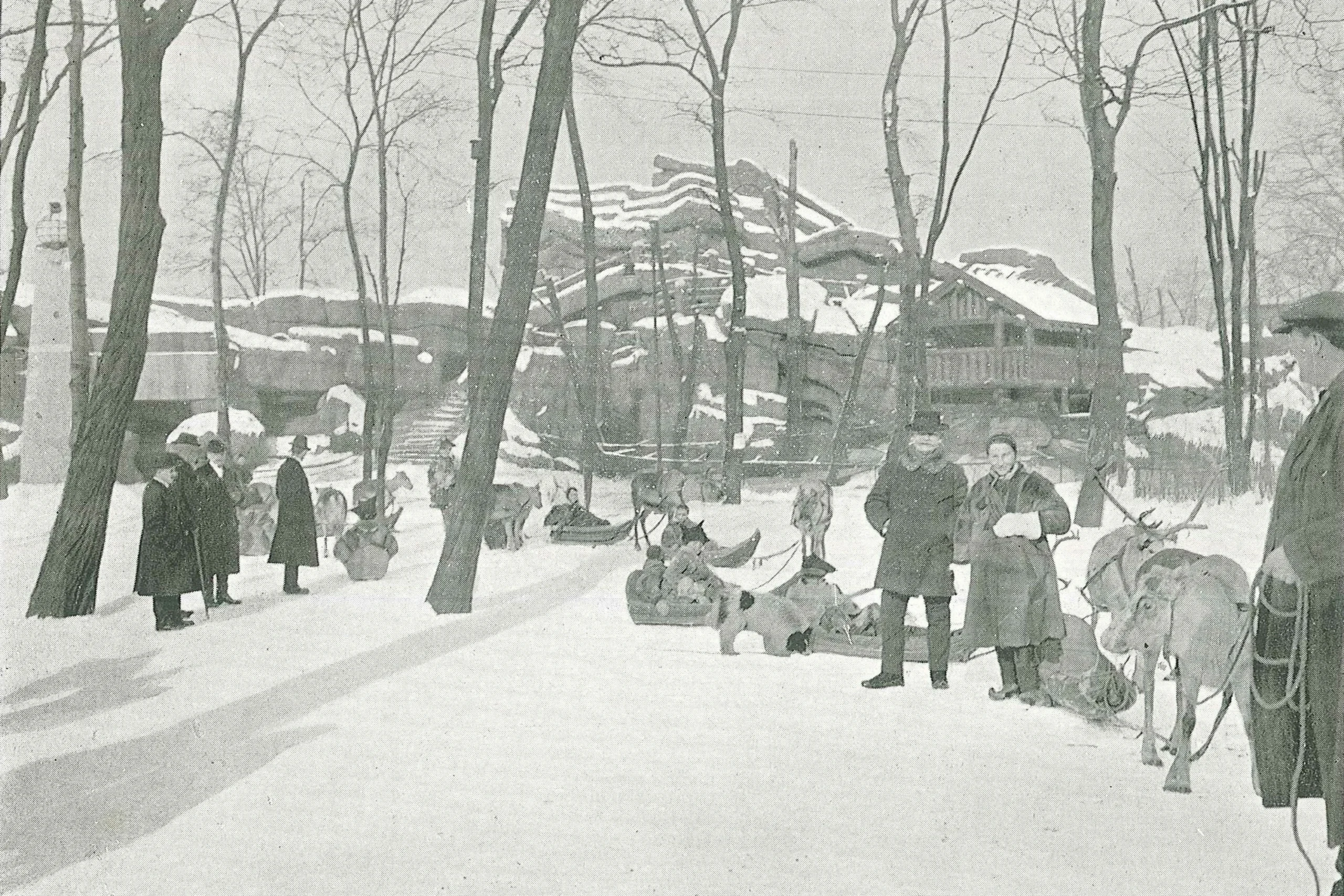
Before the Second World War, and especially in the 19th century and the early 20th century, the Zoo welcomed visitors during the winter months not only with animal exhibits but also with ice-skating rinks and sledding hills. As part of our jubilee anniversary year, we are now recalling these winters of the past.
In an earlier article, we already mentioned that our Zoo will celebrate its 160th anniversary this year. While the actual birthday will not be until August, we have declared the entire year of 2026 a jubilee anniversary year. As part of this, we regularly publish articles on our website that bring the Zoo’s past to life. This time, we are looking back at winters of earlier times—especially fitting given the recent cold weather and heavy snowfall.
In the first decades of the Zoo’s history, there were relatively few indoor exhibition spaces. Animals that required warmth did have indoor enclosures, but heated visitor areas were rare, so there was limited animal-related sightseeing during winter. At that time, our predecessors encouraged winter visits by creating ice-skating rinks and even sledding slopes within the Zoo. There was strong demand for this, as Pest had few suitable slopes for sledding, and the City Park sledding hill did not yet exist (it was built between 1974 and 1978 and was named Király Hill after 1983, following the premiere of the rock opera Stephen, the King on its hillside). Although the history of the City Park ice rink began relatively early, in 1869, many people still preferred to skate at the Zoo.
This tradition continued even after the major reconstruction of the Zoo between 1909 and 1912, which still defines its architectural character today. Winter sports activities had two main locations. One was the Great Lake, which in those days froze over completely almost every winter. Along the steeper shoreline—roughly where the Crocodile House stands today—there was a sledding and toboggan run. The other location was where the playground and the railway-side end of the Savanna enclosure are now situated. This large, flat area was originally reserved for ethnographic displays, but during winter frosts it was flooded with a shallow layer of water, creating a good-quality ice-skating rink. In the 1910s, visitors could even ride on sleds pulled by reindeer.
These activities were widely promoted under the name “Winter Sports at the Zoo” and were quite popular for a time. Later, however, interest declined, as more and better opportunities for skating and sledding became available elsewhere in the city. Improvements in public transport also made it easier for people from Pest to travel by bus or tram to the Buda side, which offered many more suitable slopes for sledding. In addition, creating ice rinks and sledding runs caused considerable disturbance to the Zoo’s animals. For these reasons, such activities have not been part of Zoo life for the past eighty years.